
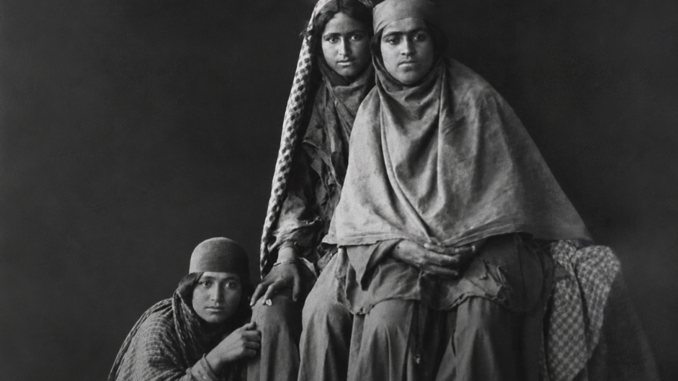
In the early 20th century, Persia was a nation gripped by political turmoil, economic despair, and deep social injustice. By 1905, under the oppressive rule of corrupt local and provincial authorities, much of the population, especially in rural regions, lived in abject poverty and discontent. That year, a natural disaster deepened the crisis: a devastating locust invasion swept across the Khurasan provinces, destroying staple crops like wheat and barley. As food supplies dwindled, prices soared, and daily survival became a struggle for millions.
Rather than offering relief, the ruling elite increased pressure on the population. Heavy taxes were imposed on already-impoverished peasants. Those unable to pay were pushed to desperation—some fled their lands, others sank further into destitution. In Quchan, this economic cruelty reached its tragic peak when local officials forced peasant families to sell their daughters to cover tax debts and other dues.
Reports documented the sale of at least 163 girls from Quchan to Turkmens and Armenians, though some eyewitnesses claimed the number reached 300 or more. These girls were believed to have been trafficked into Central Asia’s slave networks, where they became domestic servants, concubines, or prostitutes. The incident shocked the nation’s conscience and ignited fierce debates in the newly formed Majlis (parliament) during the Constitutional Revolution.
In response to this atrocity, Ali-Akbar Dehkhoda, a leading intellectual and poet of the time, wrote the poem Dokhtar-e-Quchan (The Daughter of Quchan), published in the newspaper Sur-e Esrafil (صور اسرافیل). This piece became one of the earliest nationalistic poems of the Constitutional Era, commemorating the pain of an oppressed people and calling for justice and reform.
The tragedy also endures in folk memory. The regional folk song Dokhtar-e-Quchani, also known as Yek Duneh Anar (“A Single Pomegranate”)—«دختر قوچانی» یا «یه دونه انار»—uses poetic imagery to convey lost innocence, cultural identity, and quiet resistance. It remains a living testament to the collective trauma and enduring spirit of a nation long denied its dignity:
“One pomegranate, two pomegranates—three hundred pearl-like seeds.
The sun is shining over the mountain peak, and the samovar is boiling.
My beloved wears a golden carafe on her shoulder and sells glances with a wink.”
Inspired by Dokhtar-e-Quchani song, the poem “One Pomegranate, Three Hundred Seeds”, honors the memory of the lost daughters of Quchan in 1905.
One Pomegranate, Three Hundred Seeds
Beneath the Khurasan sky so wide,
Where wheat once swayed in humble pride,
The locust came—a blackened tide—
And hunger walked the countryside.
The sun rose hard on cracked, dry land,
Where fathers held out blistered hands,
But coinless palms met cold demand—
The taxman’s law, the ruler’s brand.
And when the soil no harvest gave,
And none were left with gold to save,
They bartered daughters, pale and brave,
To pay the price the tyrants crave.
From Quchan’s hills to Turkmen tents,
They vanished—chattel, evidence—
Of how a state with no defense
Can sell its soul in pestilence.
No bridal songs, no farewell rites,
Just silence swallowed by the nights.
Their names unetched in legal lights—
Their pain, a torch in poets’ fights.
Oh, Dokhtar-e-Quchan, your tears
Still salt the edge of modern fears.
Your pomegranate smile appears
In every girl who disappears.
The samovar may boil again,
And songs may rise from mountain men,
But if we do not wield the pen,
Your ghost shall walk among us then.
For what is time, when justice sleeps?
What use are laws the tyrant keeps?
The past repeats in cruel sweeps—
As present wails and future weeps.
Let every voice the silence break,
Let every mother’s sorrow wake
A fire no tyrant dares to take—
A dawn that no regime can fake.
One pomegranate, three hundred seeds—
Each holds a name, each name still bleeds.
Let not their story fade or stall—
The fight for freedom claims us all.
Nader Rahimi is a scientist, poet, translator, and professor at Boston University. His debut poetry collection, Songs of Being, was published in 2021. In 2024, he translated The Scarlet Stone and Other Poems by the renowned Persian poet Siavash Kasrai. His third collection of poetry, Water Lily Kingdom, was published by Moonstone Press in 2025.

Leave a Reply