

You slide Mohammad’s red car into the snug parking spot, as if it were reserved just for you. After dropping Mohammad off at the shop, you’ve driven quite a long way to Niavaran, all for them to dye your hair in that exact shade you love. You dump your stuff on the seat next to you, leaving all the papers there. You just want to let go of all the bad news and, for once, think about yourself. Tossing your phone and wallet back into your bag, you sling it over your shoulder and get out. The ringing of your phone is getting on your nerves, loud and piercing. You feel like picking it up and throwing it into the gutter, but, as a few times before, you just ignore it. You reach the salon door and knock. The phone’s ring seems even louder now, like a drill digging into your temples. You try to tune your ears to the distant sounds around you—the clang of metal beams hitting the ground, the hum of cars passing by, their tires scraping against the asphalt, the shuffle of someone’s shoes. Footsteps approach the door. Finally, a woman opens it, looking as if she’s fed up with the world and not too thrilled by your appearance either. You feel like telling her you didn’t come to admire her looks; you came to let go of everything. You’ve come to dye your hair fiery red, just like you’ve always wanted—and just the way Mohammad disliked. He’d say it made him feel uneasy, as if bad news were on the way. Red, he’d say, was only for cars. But you wanted to feel like someone else, someone who didn’t have to drop Mohammad off and then head to the lab. Someone different. Another woman. At least for today. At least for now.
You stay silent. A smile creeps across your face, unbidden. Deep down, you know it’s the most ridiculous smile in the world. You step inside, take off your coat and scarf, and just as you’re about to hang them, the woman takes them from you as usual. As you hear the familiar chime of your phone, you know that sooner or later, you’ll have to tell him everything. But not now. Not when you’re finally yourself—your true self, with long black hair.
Flustered, you hand over your bag to the same woman who opened the door for you and say, “Could you put this next to my coat and scarf too?”
Without waiting for an answer, you walk down the room and sit down on one of the chairs. You sit and begin observing the glamour junkies around you and their pretentious gestures. A few women are getting their hair dyed. A little boy picks up one of the magazines and talks to the woman with red hair in one of the pictures. He calls her “mom.”
One of the hairstylists approaches you with a smile and says, “If you need a color treatment, come and take a look at the color samples.”
You glance at the woman seated beneath her hands, her entire forehead stained with color. You don’t want her to be careless and splash color all over, giving your hair a color that’s out of style and doesn’t fit the current trends. You don’t want to think about the future unfolding before you.
You reach out to pick an album as she says, “This one is from Sudi. This one, with ‘Mahnaz’ written on it, is mine, dear. Take this one instead.”
You realize her name is Mahnaz, and she seems too nosy, while you seem frustrated. Yet you keep flipping through the pages. A red-haired woman with striking green eyes catches your attention. She resembles the woman the little boy is talking to—blonde hair, blue eyes. You wonder if their photos would still be this captivating without those eye colors.
You glance at your dark eyes in the mirror. There’s no doubt in your mind that no matter what color you dye your hair, you’d never hold a fraction of that beauty. You mutter to yourself: What part of me has ever resembled other people, that this one would be any different?
You keep flipping. Suddenly, your eyes freeze on the photo of a blonde woman. Her face feels oddly familiar.
Mohammad’s mother sits beside you, running her hand through her blonde hair as she says, “My dear, this isn’t the Stone Age anymore—there’s always a way to have kids.” You know she can’t stand you. You haven’t forgotten how hard it was for Mohammad to convince them to accept you. You still remember her telling Mohammad, “She’s been scarred by her stepmother, and she’ll burn you too…”
You glance at Mohammad, standing by the window, his eyes fixed on the garden, trying to mask his feelings with an air of indifference, but you can see right through him. You know how much he loves children. You know that very well, in every unspoken word.
“You think I wouldn’t want to be a mother?” you say. “But it costs money, maman jan.” The words leave a bitter taste in your mouth as you call her “maman jan”. You know, deep down, that you don’t even accept her as a mother in the slightest. Even if you spent an eternity mourning the absence of your own mother, you’d never want her to fill that void. Motherhood isn’t a title you hand out lightly. It’s not a name you can give just anyone.
What you truly yearn for is to become a mother yourself—to show the world, once and for all, what it really means to be one.
Mohammad interrupts. You can tell that he and his mother have already talked about this. He says, “Maman and the others will cover some of the expenses. The rest—whatever happens—we’ll sell the shop.” You know that his mother and the others don’t have a penny to spare, and that Mohammad has made up this story to make you feel embarrassed. He glances at his mother sideways and smiles.
Mahnaz steps in front of you, smiles, and asks, “Have you finally made your choice?”
Once again, you force a smile, and reply, “Red. One of those reds.” You point to the image of a woman with fiery red hair. The hairdresser studies your face, probably wondering to herself whether it will suit you. She curls her lips in a half-smile, pretending it’s not a bad choice. You tell her firmly, “I want this color.” She tilts her head and forces a smile. Now, it’s not just your smile that seems ridiculous.
She helps you stand up and guides you to a vacant chair in front of the mirror. She ties a cloth apron around your neck and begins preparing a bleaching solution for your hair. You ask, “Does it need bleach?”
She replies, “For this color, yes.” She pours the entire container onto your head. Your scalp begins to burn.
The person sticks a needle into your hand and fills a few vials with blood.
Mohammad has already given his sample and is now standing beside you. He runs his hand through your black hair and says, “By the time the test results come in, the shop will be sold, and we can start a family right away.” You’re not sure whether he sees you as part of that dream or whether it’s only about him. Deep down, you secretly hope that if you ever have a child, the first word they say will be “Mom,” not “Dad.”
The technician places the vials of red blood into a container, presses cotton against the puncture, and says, “Come back in two weeks for the results.”
You turn to Mohammad and say, “We should see a doctor too—just to be sure. It would be better if we both got tested.”
You know Mohammad won’t agree to be tested, and in the end the whole burden will fall on you.
Now comes the turn of the red dye. The hairdresser carefully applies the red color with a brush to your bleached hair. Even before she finishes, you can see your hair turning red. The woman who opened the door earlier switches on the television and says, “My son just called saying a building in the south of the city has caught fire.” You know that, for many of them, anywhere below Vanak Square is considered the south of the city.
Before she can finish her sentence, the television screen brings Plasco into view. The entire building is engulfed in flames, burning fiercely. Your eyes flicker back and forth, fixated on the red and yellow blaze. Your head feels like it’s on fire. You want to get up and rush to your phone. Your mind races with anxious thoughts. You feel sick to your stomach.
As Mahnaz, her eyes fixed on the television, comes over to you and says, “Let me have a look at your hair,” you slump into the chair without a second thought, feeling like a piece of meat, lifeless and passive. You don’t have the heart to protest. You let her check your hair, or do whatever else she wants, just to get it over with. But your eyes never leave the television screen. A shiver runs through your whole body. Your head is rinsed under the faucet, and the burning sensation fades. It’s as though you’re just beginning to understand what’s happening.
In your mind, Mohammad is screaming, running through your thoughts. Mohammad is burning along with all the goods in the shop. You scream. The woman who opened the door rushes into the back room and quickly returns with her purse in hand. It seems she’s realized someone close to you may be caught in the fire. You grab the purse and pick up your phone at once.
The phone quivers in your hand as you fumble to unlock it. Mohammad hasn’t called you in the past few minutes. You scroll to his name, alongside the two heart emojis you’ve placed next to it. You press dial. It rings. Your eyes stay glued to the TV. The flames are rising higher. Fire trucks stand by the building. It rings. Firefighters, hoses in hand, stand next to the structure. It rings. The fire rages and climbs upward. The call disconnects. You scream. This must be what labor pains feel like—like all your bones are shattering and exploding inside you.
The little boy isn’t flipping through the magazine anymore. He’s standing right in front of you, blocking the TV. On either side of his head, the building is in flames—burning, burning. You try Mohammad’s number again. The two little hearts next to his name on your phone are pulsing—bright red. The flames on the screen, red and yellow, are licking higher and higher.
“The number you’re trying to reach is unavailable.”
The fire rages around the boy’s head on the TV screen.
“The number you’re trying to reach…”
The flames roar higher.
“…is unavailable.”
The building crumbles, and the shrill tone of a busy signal rings in your ear.
The women’s screams, along with Mahnaz Joon’s, fill the room, but inside you it’s as if a switch has flipped—everything falls silent. You catch a muffled voice saying, “Congratulations.” You whip around to look at the others. No one is speaking. They’re all staring at the TV, their wide, bewildered eyes occasionally flicking over to you. They’ve put two and two together. They know you’re somehow connected to all this.
The little boy dashes over to a woman with black hair sitting across from you, yelling, “Mom!” as he buries his face in her arms. She’s the kind of woman you always wished you could be—someone completely different.
You can’t even remember whether you paid the bill or not. In fact, you don’t even remember when you put on your coat and scarf. You have no idea when you walked out. Your hair, like fiery sparks, is spilling out from under your scarf. You slump into Mohammad’s red car, lean back, and sit there, unsure of what to do next. You feel like stepping on the gas and heading straight to the shop that’s no longer there. You saw it with your own eyes—it came crashing down. You’re sure the place must be in chaos right now. There’s no way you’d make it there through all that traffic.
Your phone rings. You don’t even know how you manage to dig it out of your bag. Mohammad’s name pops up on the screen, alongside two heart emojis. You cry out, fumbling as you hurriedly pick up the call.
Mohammad speaks in a choked voice, “Our life’s gone up in smoke, Bahareh.”
You don’t care. You can hear him sobbing. You know his mind is racing, thinking about everything that has happened—the stock he had piled up in the shop and all the people trapped under the rubble right in front of him. You’re sure that, in the middle of all this chaos, the last thing on his mind is the child. You know now that even if they sold the shop, there would be no money left for fertility treatment. You mumble, “Forget it.” It’s the same thing you wish he would say to you when the test results come back.
You gather up the papers lying on the seat next to you. On the way, you stop by a trash can. All the documents that scream “future father” or “never a father” have to be thrown away. You start the car and drive toward home. Once again, the image of fire flares up in your head and bursts outward. It’s just like the way your red hair dances in the wind.
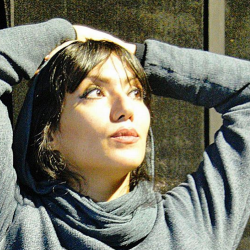
Pajand Soleymani is an Iranian writer and linguist based in Tehran. She holds a PhD in Linguistics from Allameh Tabataba’i University and works across fiction and interdisciplinary research on language, culture, and literature. Her literary work includes poetry, short stories, novels, and plays. Several of her works have been published internationally, including the German editions of Hamisheh ba Shekar (Immer mit Zucker) and Pāyān e Khedmat (Das Ende der Dienstzeit). She is also the editor in chief and publisher of Payam Charsoo Magazine and Publishing House.

Leave a Reply